
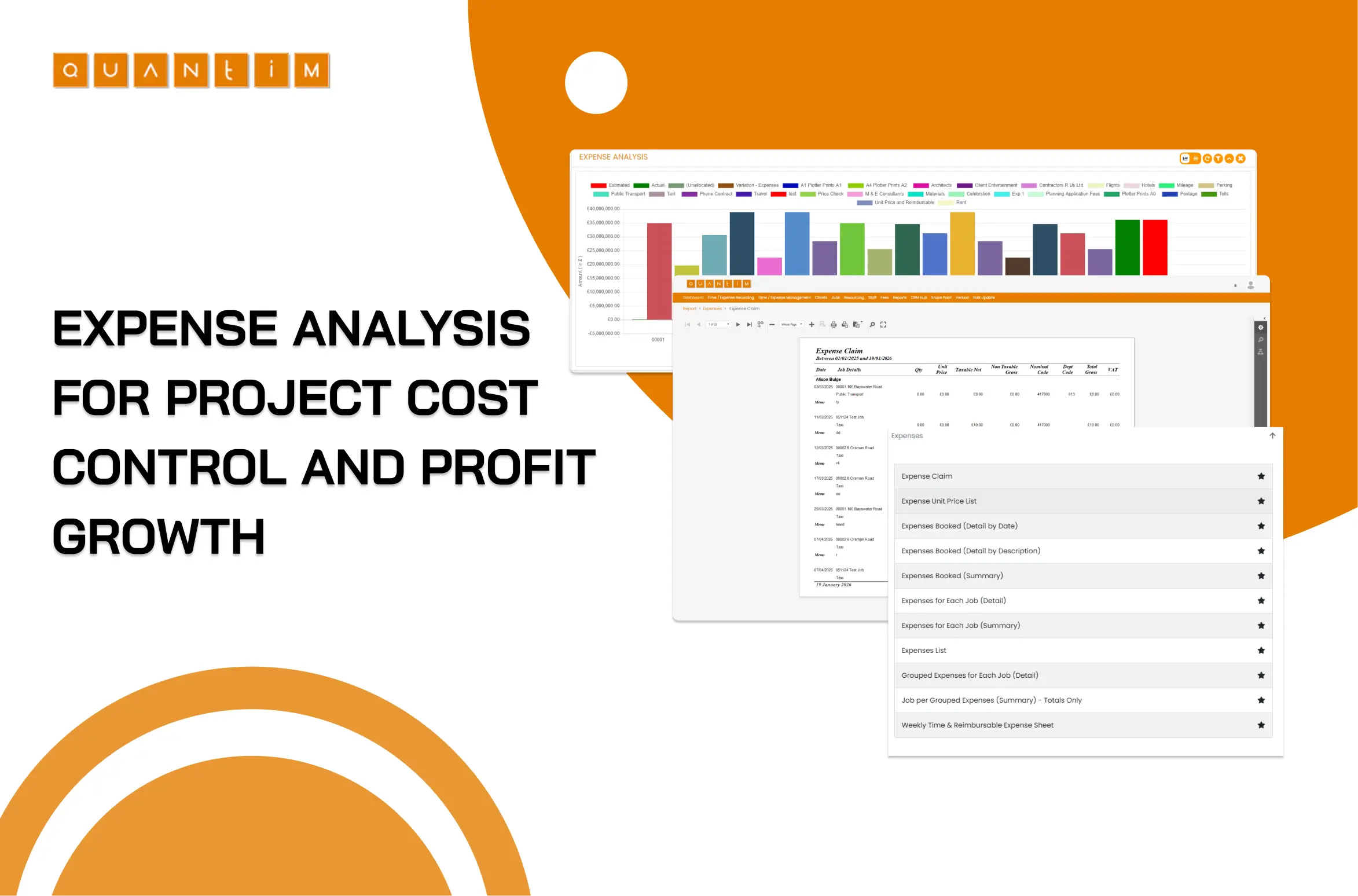
Expenses influence profitability more than most organisations recognise. When costs are submitted late, captured inconsistently or approved without proper checks, businesses lose visibility over their true financial position. The result is inaccurate billing, weak forecasting and preventable leakage.
Many teams still use spreadsheets or informal methods to log expenses. This leads to missing receipts, unclear categorisation and unreliable reporting. A structured expense analysis framework creates clarity and ensures every cost is captured, validated and linked to the correct job.
This article explains why expense analysis matters and how Quantim provides a modern, real time system that strengthens financial accuracy across the organisation.
Why Expense Analysis Matters
1. Clear Visibility of Operational Spend
Managers gain an immediate view of where money is being spent, how frequently and by whom. Patterns become visible quickly, helping leaders intervene before costs escalate.
2. Protection Against Revenue Leakage
Reimbursable costs often go unbilled due to missing details or poor tracking. Accurate expense analysis ensures organisations capture every recoverable cost.
3. Better Planning and Forecasting
Reliable expense data feeds into job costing, WIP, forecasting and profit reporting, creating a stronger financial foundation for decision making.
4. Stronger Financial Discipline
A structured system encourages staff to submit complete, accurate entries with supporting receipts. This reduces ambiguity and builds accountability.
How Quantim Makes Expense Analysis Easy and Accurate
Quantim provides a complete end to end expense workflow that eliminates guessing, inconsistencies and spreadsheet dependence. Instead of focusing on individual fields, Quantim focuses on structure, clarity and compliance.
1. Expense Entry: Simple, Guided and Consistent
The Expense Entry screen in Quantim standardises how every staff member records costs. Users select the relevant job, the expense type and supporting details, then upload receipts. The interface guides staff through a clean, controlled process that ensures:
- Every expense has the required information
- Receipts are stored securely
- Reimbursable items are flagged correctly
- VAT and accounting rules are consistently applied
The goal is simple: complete and accurate submissions without heavy admin work.
2. Validation and Logic Behind the Scenes
Quantim automatically applies organisation level rules such as:
- Whether an expense type is billable
- Whether VAT should be applied
- Whether a memo is required
- Whether the expense can be deleted
- Whether the expense belongs to a job or general operations
These rules remove ambiguity and reduce financial errors before they even reach the approval stage.
3. Approvals: A Structured Review Process for Managers
Once submitted, expenses move into the approval workflow. Managers and finance teams see a clear list of pending expenses with:
- Receipts
- Job links
- Notes
- Reimbursable indicators
Approvers can approve, reject or request updates in seconds. There is no need to chase staff or piece together missing information.
The approval workflow ensures:
- Compliance is maintained
- Costs are reviewed before hitting financial reports
- Incorrect submissions are corrected early
- Sensitive changes are restricted by role based access
4. Real Time Impact on Job Costing and Profitability
Once an expense is approved, it updates the financial ecosystem instantly. Quantim reflects the cost across:
- Job Activity Analysis (Actual vs Estimate)
- Job Cost Summary (Cost vs Charge)
- Cost vs Recovery reporting
- Fee raising and invoicing
- WIP and forecasting models
Managers no longer wait until month end to understand project cost performance. Every update is immediate.
5. Advanced Reporting for Deeper Insight
Quantim provides multiple reports that help organisations understand spending patterns and financial health, including:
- Daily and monthly expense summaries
- Job level expense breakdowns
- Grouped expense reports
- Reimbursable sheets
- Drill down cost analysis
These reports allow managers to identify high cost categories, spot trends early and strengthen financial planning.
6. Seamless Integration with Accounting Systems
Quantim connects cleanly with accounting platforms such as Sage.
The system ensures:
- Correct nominal codes
- Accurate VAT handling
- Only approved expenses are posted
- Internal costs can be excluded
This avoids manual reconciliation and prevents accounting mismatches.
7. Access Level Control: Financial Data with Proper Boundaries
Quantim restricts who can:
- Submit expenses
- Approve them
- Edit or delete entries
- View job level costs
- Access organisation wide financial summaries
This ensures sensitive financial information is protected and responsibility is clearly defined.
8. Dashboards: Real Time Expense Intelligence
Quantim’s dashboard provides a high level view of:
- Total spend
- Reimbursable vs non reimbursable costs
- Job wise spending
- Staff behaviour
- Trends over time
Every dashboard updates instantly as expenses move from submission to approval.
Conclusion: Expense Visibility Protects Profitability
Strong expense analysis is not just a finance requirement. It is a critical operational capability. Organisations that track expenses accurately gain better control of margins, clearer insight into job performance and reduced financial risk.
Quantim gives businesses a structured, real time expense system that removes guesswork, eliminates leakage and connects every cost to the broader financial picture. With guided entry, controlled approvals, advanced reporting and live dashboards, Quantim turns expense management into a genuine strategic advantage.
If you want to transform how your organisation handles expenses, Quantim delivers the clarity, structure and intelligence needed to maintain accuracy and protect profitability.