
Work in progress tracking should bring order to a project, yet for many teams it becomes a constant source of confusion. When updates arrive late, data is incomplete or information is scattered between different tools, WIP tracking turns into guesswork instead of reliable insight. Leaders are forced to rely on status chatter, gut instinct and meetings rather than clear facts.
This shift from clarity to chaos does not happen overnight. It starts with small gaps in communication, fragments of data that never make it into the system and blind spots in how progress is reported. To move from chaos back to clarity, teams need to understand where these blind spots come from and how software like Quantim can quietly remove them from everyday work.
Problem core: the hidden cost of blind spots in WIP tracking
Behind every delayed project report or stressed status review there is usually the same root problem. The team is working hard, but no one has a single, trusted picture of what is actually in progress and how close each job is to completion. Work looks active in chat tools and meetings, yet the formal WIP data is old, partial or missing. Project managers see activity everywhere but still cannot answer basic questions about progress with confidence.
These blind spots have real costs. Decisions get made late because risks are not visible early enough. Clients lose confidence when answers keep changing between one review and the next. Finance teams struggle to prepare accurate WIP and revenue reports on time. The result is more time spent chasing updates and less time spent improving project outcomes. Quantim addresses this problem by turning WIP tracking into a structured, cloud based workflow that captures progress at the source instead of leaving it buried in chatter.
Old days vs new days in WIP tracking
In the old days of WIP tracking, teams relied heavily on spreadsheets, long email threads and manual status meetings. Updates were typed into Excel at the end of the week, often copied from notes or memory. If someone forgot to update a cell or used a different version of the file, the whole report became unreliable. This approach made it easy for errors and missing entries to hide inside the file until someone caught them during a stressful review.
In modern teams, work moves too fast for this approach. Projects run across multiple locations, flexible working hours and many digital tools. WIP needs to be visible in real time, not just in a spreadsheet that someone updates when they have a spare moment. Cloud based WIP tracking software gives everyone access to the same live view of jobs, activities, hours and costs. Quantim is designed around this new reality, providing a single, always current WIP workspace that replaces manual consolidation and version chasing.
Blind spots hidden in everyday chatter
1. Busy channels, but no structured progress
In many teams, most progress discussion happens in chat apps, group messages and informal calls. People send quick updates such as “almost done” or “working on it” without linking these messages to a specific activity or job. Important details are scattered across different conversations, and by the time someone prepares a WIP report they have to scroll back through days of messages to reconstruct what really happened. Communication noise hides the signal the team actually needs.
Quantim solves this by giving every job and activity a structured place for progress updates where hours, status and notes are captured in context. Instead of living only in chat, updates are entered directly against the work item so that WIP views and reports always reflect the latest information without manual reconstruction.
2. Status meetings that never become data
Another common blind spot appears when most detail is shared verbally in recurring meetings. Team members explain progress, blockers and estimates on a call, everyone nods, and then the meeting ends without those updates being captured in the system. If someone is absent or a manager checks the WIP later in the week, the data tells a different story to what was discussed. Over time, this gap between spoken status and recorded status undermines trust in WIP tracking.
With Quantim, meeting outcomes turn directly into updated WIP data. Project managers can open the relevant job or activity during the call and record progress, remaining effort and notes on the spot. The system becomes the shared memory of the meeting, which means that anyone who checks WIP after the call sees the same facts that were agreed in the discussion.
3. Optimistic language that hides aging WIP
Project teams are often naturally optimistic. People say tasks are “almost done” for several days in a row, even when the work is still only halfway complete. Without tools that highlight aging WIP, these items can sit in the system for weeks without clear attention. Leaders hear positive updates, but the age and size of the open work quietly grow in the background. Studies on WIP and Kanban emphasise how important it is to monitor aging work and limit items in progress to prevent bottlenecks and slow delivery.
Quantim helps teams confront this reality by showing how long each job or activity has been at its current stage and how much effort is already logged. Visual cues and progress views draw attention to aging WIP, making it easier to challenge vague “almost done” language and replace it with concrete updates inside the system.
4. “No news is good news” gaps
When teams are busy, they sometimes fall into a pattern where they only speak up when something is urgent or blocked. The absence of updates is treated as a sign that everything is fine. In reality, silence can hide slow moving risks, unreported scope changes or small delays which later combine into a serious problem. Communication research calls this a blind spot in monitoring and control, where the lack of feedback is misread as positive feedback.
Quantim closes this blind spot by supporting simple update rules and automatic reminders. For example, each active job can require at least one structured WIP update in a defined period. If no update is provided, the job is flagged in the WIP view, prompting the responsible person to record progress. This turns “no news” into an actionable signal instead of a quiet risk.
5. Feedback that is collected, but never connected
Some organisations already collect feedback through start, mid and end of project questionnaires. The problem is that these responses are often stored in separate survey tools or shared folders and are never linked to WIP. Lessons learned stay trapped in documents rather than influencing everyday progress decisions. Valuable comments about communication, scope clarity and coordination are read once and then forgotten before the next project starts.
Quantim allows teams to connect feedback directly to jobs and activities. Questionnaires at the start can capture expectations and risks, mid project surveys can surface communication issues early and end of project forms can highlight improvements. By linking this feedback to actual WIP data, teams can see patterns across jobs and use them to refine update rules, templates and progress workflows in the system.
What clarity in WIP tracking looks like
When WIP tracking is clear, leaders can open a single view and immediately understand what is in progress, how far each job has moved and where attention is needed. Reliable data supports realistic scheduling, because early signs of delay stand out instead of hiding behind optimistic status messages. Teams can adjust resources or priorities confidently, knowing that the figures they see are grounded in actual time and cost entries rather than assumptions.
Clarity also changes the feeling of reporting. Instead of rushing to assemble numbers before every review, teams can generate WIP and financial reports quickly from the same structured data used to manage work every day. This consistency speeds up month end processes and gives finance teams a stronger basis for revenue recognition, forecasting and margin analysis. Quantim is built to provide this level of clarity, turning the WIP module into a live operational view rather than a static report that is updated only at month end.
How Quantim cloud software turns chaos into clarity
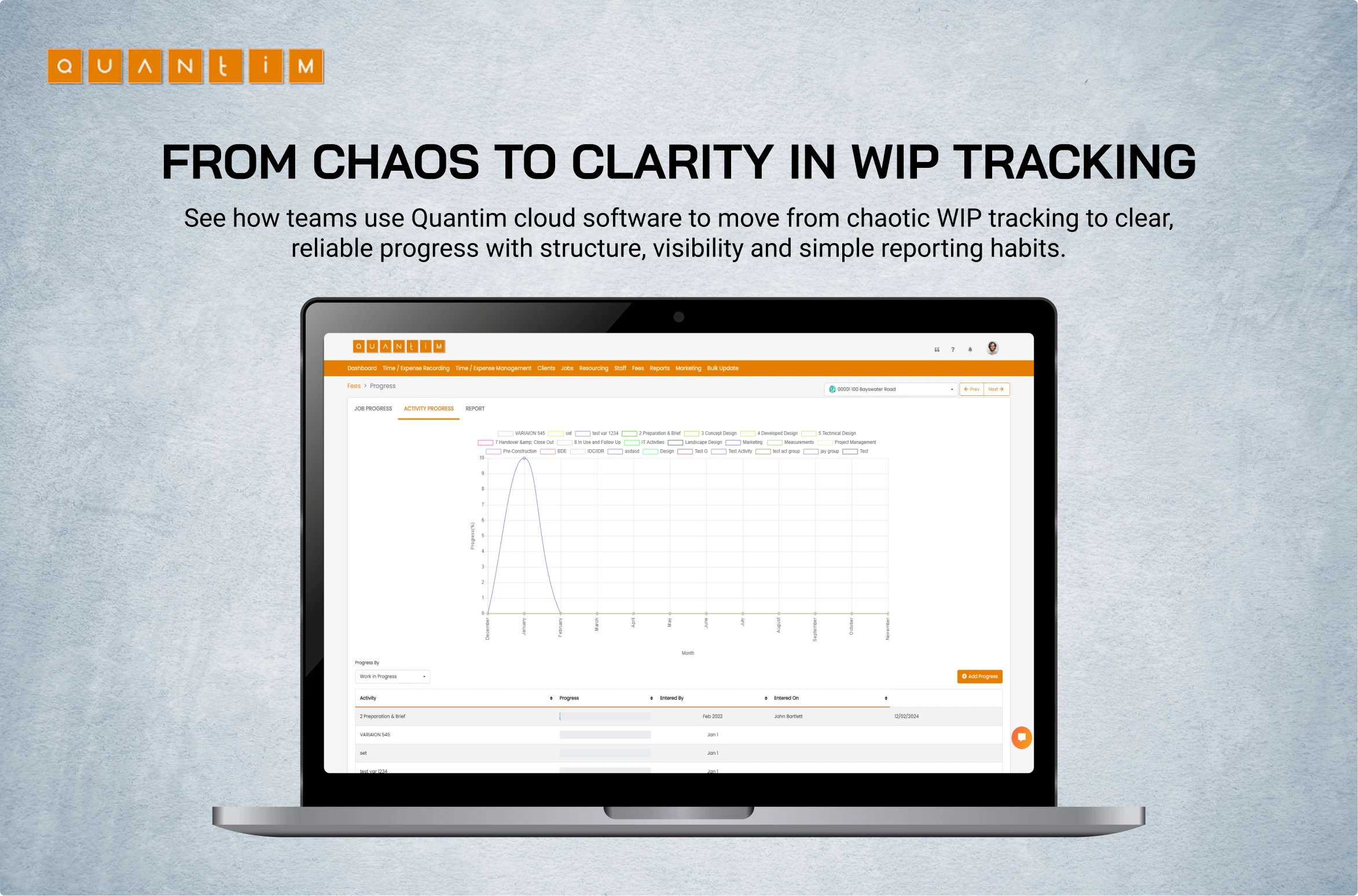
Quantim offers a dedicated Work in Progress area designed for engineering, construction, consulting and other project based teams. Jobs and activities are tracked in a structured way, with options to view progress by fee quote, resourcing or WIP at both job level and activity level. Each update records hours, costs and narrative in context, so nothing important is left trapped in chat threads or meeting notes.
A built in WIP report view brings together job progress, activity status and financial performance in one place. Managers can filter by client, project type, department or time period and instantly see which jobs are on track and which ones need attention. Because Quantim runs in the cloud, everyone works from the same live data, whether they are on site, in the office or working remotely.
Quantim also supports automation that reduces manual admin. Teams can configure simple rules for how often WIP updates are expected and use reminders to encourage consistent behaviour. Integrated timesheets and resource planning feed directly into WIP, so hours and utilisation are reflected automatically rather than being typed in later. Together, these capabilities transform WIP from a manual chore into a natural part of daily project work.
Bringing continuous feedback into WIP conversations
Feedback is most powerful when it is regular, short and connected to real work. Instead of treating questionnaires as a formality at the very end of a project, teams can use three lightweight check in points. At project start, a short questionnaire can capture expectations, risks and communication preferences. Midway through, another quick survey can ask whether updates are clear, if deadlines still feel realistic and what is causing stress or confusion. At the end, a final form can reflect on what worked well and what should change next time.
Quantim helps make this feedback part of the same story as WIP tracking. Responses can be stored against the relevant job, so comments about communication gaps or reporting friction sit alongside progress data. Over time, patterns emerge that highlight where update rules need adjustment or where training and templates can remove recurring problems. This continuous feedback loop means that WIP practices do not stay fixed but keep improving with every project.
Practical steps to move from confusion to clarity
Moving from chaotic WIP tracking to a more controlled approach does not require a big bang change. Teams can start by choosing a single source of truth for WIP and committing to use it consistently. Next, they can define clear, simple rules for how and when updates are recorded. Then, they can gradually integrate automation and feedback, using reminders and questionnaires to keep information flowing without adding heavy admin work.
Quantim is designed to support this journey step by step. The system can start simply as a central place to record job and activity progress and then expand to include structured WIP reporting, timesheets, resourcing, feedback forms and analytics as the team matures. Each improvement increases visibility, reduces blind spots and makes WIP conversations more factual and less stressful.
Conclusion
Clarity in WIP tracking is not about having more conversations. It is about turning those conversations into structured, reliable data that everyone can trust. When blind spots hide inside chatter, meetings and fragmented tools, projects slow down, risks stay invisible for too long and reporting becomes a last minute scramble. When WIP is centralised, structured and supported by continuous feedback, teams regain control over progress and can focus on delivering better outcomes for clients.
Many organisations are now looking beyond basic spreadsheets and scattered updates towards platforms that make WIP visibility part of everyday work. If your team is ready to replace uncertainty with a clear, shared view of progress, Quantim cloud software offers a practical way to move from chaos to clarity in WIP tracking while keeping communication human and feedback continuous.