
For years, organisations have talked about digital transformation, automation and smarter workflows. Yet the real competitive advantage in 2026 is not the technology itself. It is the quality of the operational data that flows through a business every day.
Firms across engineering, architecture, consulting, construction, legal and IT services now operate in environments where client expectations are higher, timelines are tighter and margins are thinner. In this landscape, data quality is no longer a back-office concern. It is a direct driver of performance, profitability and long term stability.
This article explains why data quality matters more than ever, how poor data silently harms organisations and how modern platforms such as Quantim give teams a clear and reliable operational foundation.
What Data Quality Really Means in Operational Work
Data quality is not about having more data. It is about having the right data:
- Accurate
- Timely
- Consistent
- Complete
- Structured
- Actionable
In project based industries, high quality data comes from daily operational activities such as:
- time tracking
- timesheets
- job costing
- utilisation
- expenses
- progress updates
- approvals
- forecasting
- fee raising
- WIP reporting
When these data points are clean and reliable, organisations gain a complete picture of how work is delivered, how money is spent and where performance is trending. When they are not, everything becomes guesswork.
How Poor Data Quality Silently Damages Organisations
Many firms believe they have a performance issue, a resourcing issue or a profitability issue, when in reality they have a data quality issue. The impact is often invisible until it becomes expensive.
1. Unreliable Forecasting
Forecasts depend on accurate:
- hours
- spend
- progress
- job performance
- pipeline activity
Poor data creates poor forecasts. Leaders make decisions based on numbers that do not reflect reality. Budgets drift, revenue targets become unrealistic and cash flow becomes unstable.
2. Weak Cost Control
When expenses and job costing entries are incomplete, incorrectly coded or delayed:
- rework goes unnoticed
- reimbursable expenses are missed
- profit leakage increases
- WIP becomes inaccurate
- project performance appears better or worse than it actually is
Cost control starts with clean data.
3. Inconsistent Utilisation Interpretation
If timesheets are:
- incomplete
- submitted weekly or monthly
- poorly categorised
utilisation becomes misleading. Teams either appear overloaded or underutilised when neither is true. This affects:
- resourcing
- hiring decisions
- workload planning
- staff wellbeing
Poor time data damages confidence at every level.
4. Slower Decision Making
Leaders hesitate when they do not trust their data. Managers wait for revised spreadsheets. Finance waits for corrected numbers. Operations wait for clarifications. This lack of clarity slows the entire organisation.
5. Declining Client Confidence
Clients expect:
- accurate reporting
- justified fees
- transparent progress
- predictable delivery
When firms submit reports based on weak or inconsistent data, trust declines and long term relationships weaken.
Why Data Quality Has Become a Competitive Advantage
Industries are becoming more complex, not less. Competition is increasing in all professional sectors. Clients expect consistency, accuracy and transparency.
Data quality now determines whether organisations:
- win work or lose work
- retain clients or damage relationships
- grow profitably or operate blindly
- scale operations or get stuck in manual processes
High quality data improves everything from forecasting to delivery, planning, billing and staff performance. The firms that master data quality operate with clarity and confidence. The firms that do not fall behind, often without realising why.
How Quantim Strengthens Data Quality Across the Organisation
Quantim is designed to give organisations daily operational data that is accurate, structured and instantly usable. It does this without adding administrative burden. Here is how Quantim builds data quality naturally into operations.
1. Structured Time Tracking
Quantim standardises how time is captured:
- activity level detail
- clear job selection
- daily entry
- utilisation updates
- real time validation
This ensures time tracking becomes reliable operational intelligence, not guesswork.
2. Clean Expense and Cost Data
Expenses follow a structured flow with:
- guided entry
- receipt uploads
- VAT rules
- job linking
- approval checks
Every expense becomes a trusted data point for job costing, fee billing and reporting.
3. Real Time Progress and Job Performance Updates
Quantim links time, activities, fees and WIP to:
- Actual vs Estimate
- Job Activity Analysis
- Cost vs Recovery
- Remaining to Invoice
- Forecast to Complete
This turns job performance into a live, accurate indicator.
4. Approvals That Ensure Consistency
Quantim prevents poor data from entering the system by using:
- approvals
- rules
- validations
- permission controls
This keeps operational data clean before it ever reaches finance or leadership dashboards.
5. Forecasting Supported by Live Data
Because Quantim connects daily activity with financial models:
- forecasts improve
- WIP becomes more accurate
- revenue expectations become realistic
- financial risk reduces
High quality data builds financial confidence.
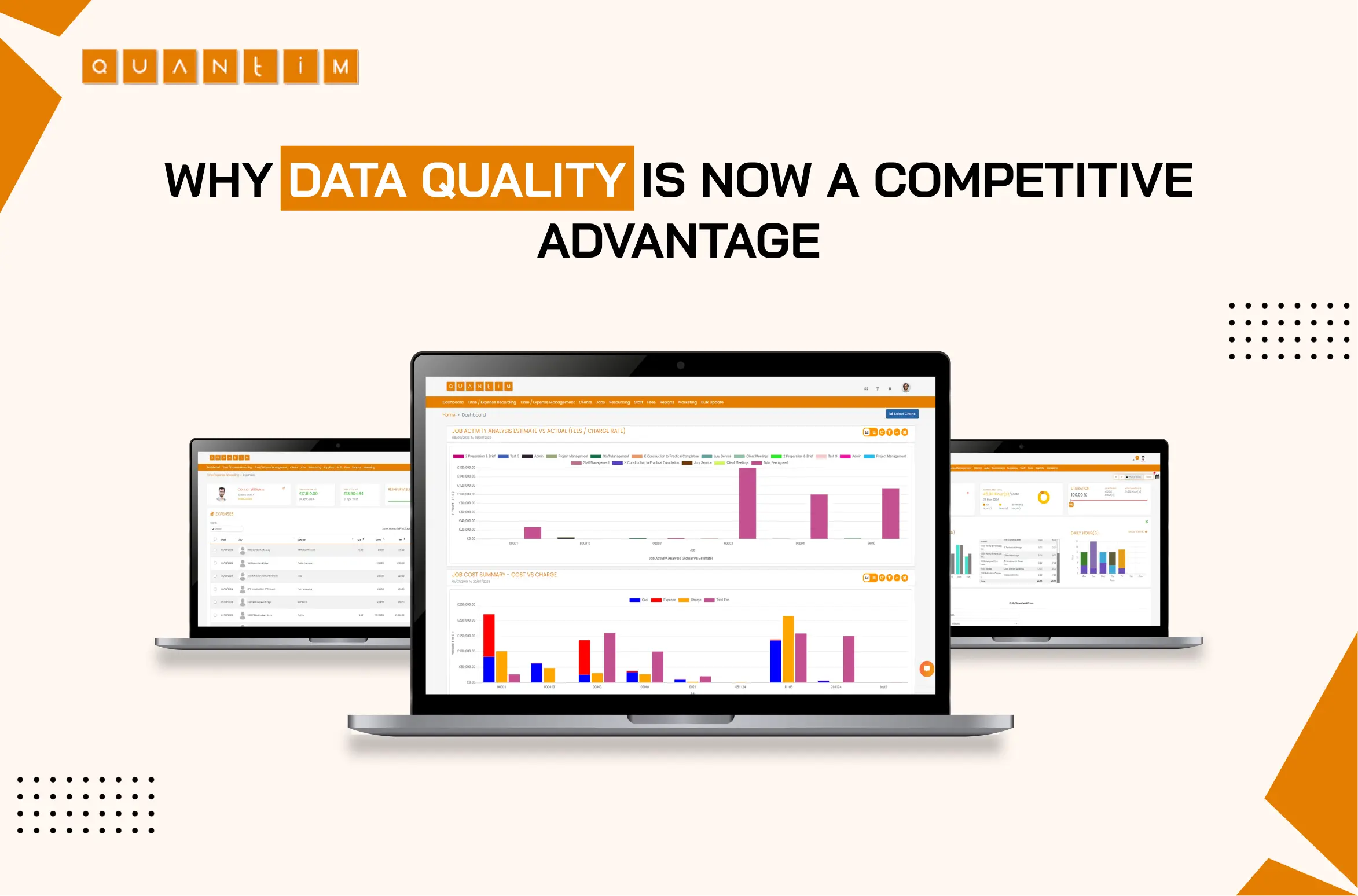
6. Dashboards That Update Instantly
Quantim dashboards show real time:
- utilisation
- job cost status
- forecasting
- progress trends
- expenses
- approvals
- KPIs
This removes dependency on manual reporting.
Conclusion: Better Data Creates Better Organisations
Data quality is no longer an internal technical issue. It is a strategic advantage. Strong data quality improves performance, strengthens financial accuracy, increases client trust and supports scalable growth.
Quantim helps organisations achieve this by transforming everyday operational data into consistent, structured and real time insight that leaders can trust.
If you want to improve operational clarity and data accuracy across your organisation, contact us at info@quantim.co.uk.